

When I started my new position on a rapid review evidence synthesis team, I spent a lot of time searching for ways to be more involved in this field of research. I wanted to identify the appropriate groups to join or follow so that I could stay informed of professional development opportunities and updates to the field of evidence synthesis searching.
I was already aware of Cochrane as the gold standard for systematic reviews, so I started my search at their website. They have some interesting educational videos about the systematic review process that I wanted to watch, but you must be a Cochrane member to access those videos [see edit below].
After further investigation, I discovered that Cochrane membership isn’t something that you pay for; it’s something you earn through contributions to the Cochrane organization. Different activities are assigned various point values; for example, publishing a Cochrane review is equal to 5,000 points, and attending Cochrane events is equal to 500 points per event. Earning 1,000 total points within 12 months will grant one year of membership. One of the easiest and most accessible ways to earn those points is to participate in the Cochrane Crowd.
Cochrane Crowd is Cochrane’s citizen scientist group that helps to categorize research into RCTs (randomized controlled trials) or non-RCTs based on title and abstract review. Anyone can participate after completing a short training exercise to make sure they know how to identify RCTs from other study types. In addition to the main reviewing task, there are also review tasks related to specific Cochrane review projects; if you review at least 250 studies, you are included in the acknowledgements in the final review. And in terms of earning Cochrane membership, each study review is worth 1 point; reviewing 1,000 studies will earn you a one-year membership.
That sounds like a huge amount of work, but with some practice, it only takes a few seconds to determine if a study is an RCT or not. Cochrane tries to help speed things up by allowing you to set certain indicator words to highlight in the title or abstract. You’re also given the option to say “I’m not sure” if a study is proving challenging to identify. I was able to review about 100 studies at a time, which took 15-20 minutes to complete.
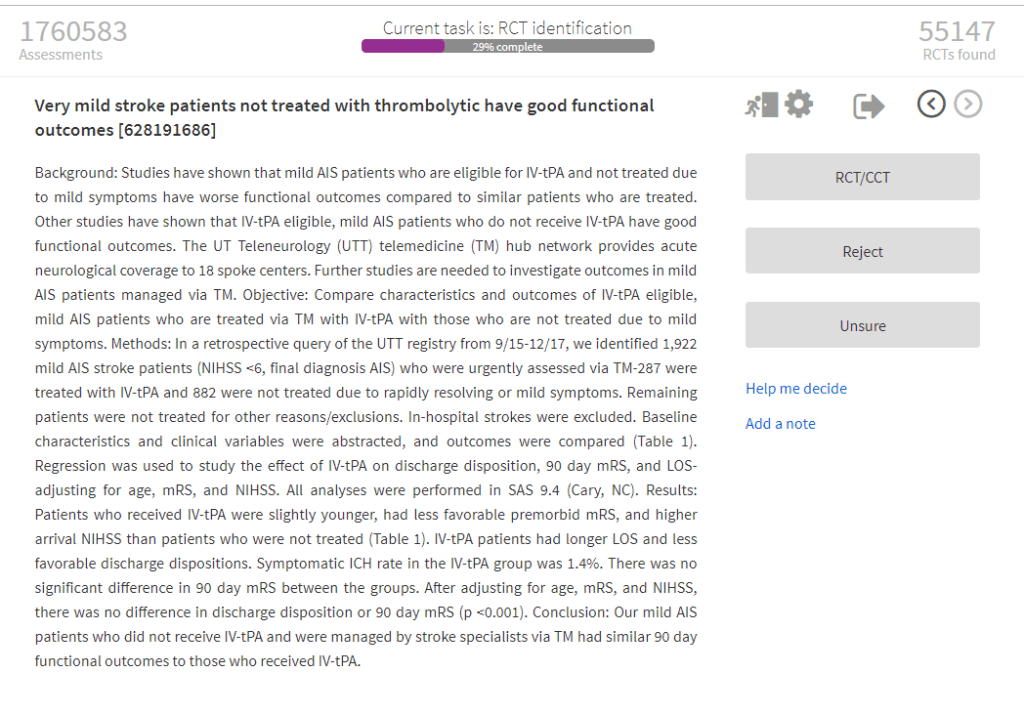
The greatest benefit to working on this project was that I developed a greater familiarity with recognizing different study types, which is a useful skill to have on an evidence synthesis team. The only thing I struggled with was my own attention span; it can get tedious scrolling through study after study, which is why I set the 100-study benchmark for each review session. It ensured that I would make noticeable progress with each session and keep me motivated to finish the project.
And I finally did finish reviewing 1,000 studies after a few weeks of on-and-off-again work on the project. I received my confirmation of Cochrane membership a few days later. Next on my list is to finally watch those videos!

EDIT: So it turns out that I initially misunderstood how accessing the Cochrane training videos actually work. There’s a series of videos on conducting a Cochrane review that is freely available to Cochrane authors and available for purchase for everyone else (members do get a discount!); the first video of this series is free. They also have a few other offerings, including tutorials on using the Cochrane library, Cochrane Evidence Essentials, and other topics relevant to creating and consuming systematic reviews. Sometimes you need to create a Cochrane account to access the learning materials, but the access is free.
Even though my primary motivation for earning my Cochrane membership was based on a misunderstanding, I’m still glad that I went through the process, and I’m looking forward to getting more involved with Cochrane in the future.
 Kathryn Vela