

Library workshops seem to be a fairly standard offering among academic libraries, especially the libraries in large institutions. My library is no different, but our experience has been somewhat uninspiring in the past. We typically hold 2-4 workshops per semester about topics like EndNote and PubMed, and these workshops usually garner an attendance rate of 0-3 people. Once, we had an EndNote workshop with 6 people, which I’m pretty sure was an all-time high.
I’ve taken a quick look at the literature to find out if this experience is typical. An article by Swanberg, Engwall, and Mi (2015) from the medical library at the Oakland University William Beaumont School of Medicine reported workshop attendance numbers ranging from 2-29, with an average of 11 attendees; catered lunches were provided at these workshops. Another article by Shurtz (2009) from Texas A&M Health Science Center reported attendance for a 5-workshop series ranging from 9-40 attendees. The Dana Medical Library at the University of Vermont shared a similar struggle with attendance prior to 2010, with an average attendance of 20 people for all workshops during a single term (O’Malley & Delwiche, 2012).
Based on this cursory examination, it seems that our library’s struggles with attendance are a common experience; our numbers on average are smaller likely because our institution is smaller than those mentioned above. In addition to our smaller size, we’re also a “commuter campus”, with no student housing on campus. This means that students are usually only on campus when they have class.
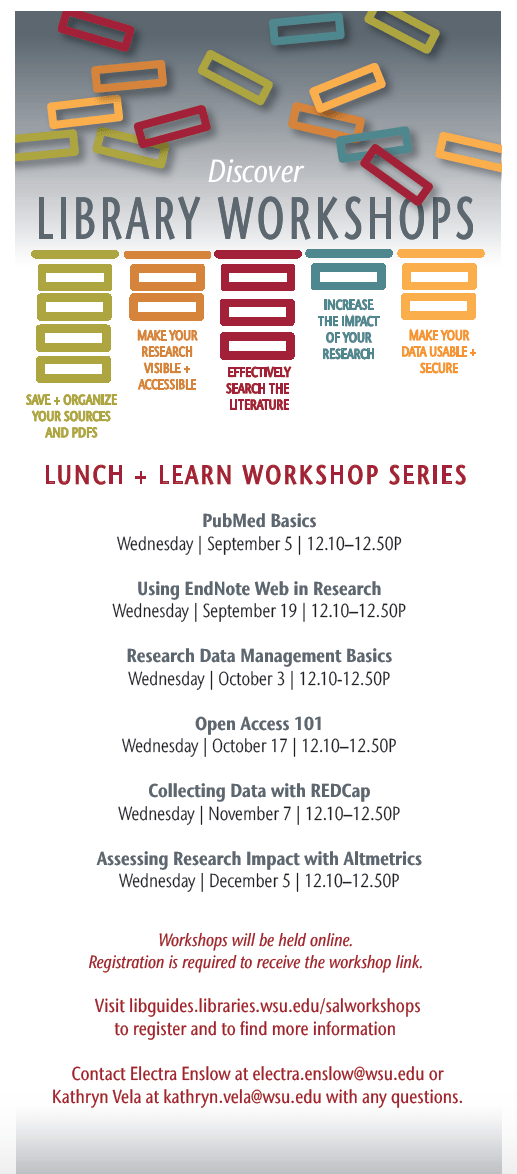
With this environment in mind, a colleague and I brainstormed potential solutions to increase attendance at these workshops during the Fall 2018 semester. We found an article by Smith and O’Hagan (2014) describing how they took their workshops online and had a successful experience. Given the greater flexibility afforded by online workshops and the ability to record sessions for later viewing, we decided to give this approach a try.
We have scheduled six online workshops for this semester, and we’ve completed three of them. So far, attendance hasn’t been great; in fact, it’s been nearly identical to our in-person workshops in the past. We’re hoping for more attendees as we go along, but if that doesn’t happen, we will likely give up on trying to make these workshops a sustainable program. Instead, we’ll make short online tutorials that may be more attractive to busy, off-campus students.
I’ll be talking about this project more over the coming weeks – has anyone else struggled with workshop attendance? Has anyone tried online workshops before? I’d love to hear about other libraries’ experiences!
References
O’Malley, D & Delwiche, FA. (2012). Aligning library instruction with the needs of basic sciences graduate students: A case study. Journal of the Medical Library Association, 100(4), 284-290. doi: http://dx.d0i.0rg/i0.3163/1536-5050.100.4.010.
Shurtz, S. (2009). Thinking outside the classroom: Providing student-centered Informatics instruction to first- and second-year medical students. Medical Reference Services Quarterly, 28(3), 275-281. doi: 10.1080/02763860903070019.
Smith, S.C., & O’Hagan, E.C. (2014) Taking library instruction into the online environment health sciences library’s experience. Journal of the Medical Library Association, 102(3), 196-200. doi: http://dx.doi.org/10.3163/1536-5050.102.3.010.
Swanberg, S., Engwall, K., Mi, M. (2015). Continuing education for medical students: A library model. Journal of the Medical Library Association, 103(4), 203-207. doi: 10.3163/1536-5050.103.4.009.
 Kathryn Vela
2 responses to “Last Ditch Attempt at Library Workshops”
[…] last time I talked about the workshops presented by my library, I discussed how we were trying a new online format to boost accessibility and attendance. During the Fall 2018 term, my colleagues and I held six […]
LikeLike
Hi great reading yourr blog
LikeLike